Establishing our new Digital Relationship Team
How we established our Digital Relationship Team to provide a clearer, more proactive link between our technology and digital specialists and services across the council.

David West
Head of Digital
There are always lots of conversations taking place across local government about new ways of working, new technology and new opportunities for change and transformation – not just about AI either.
Having headed up marketing functions as well as digital services, I certainly appreciate how important good communication, engagement and being an active part of those conversations are to enabling successful delivery of a service. So, it has been really valuable over the last four months to establish a new team within the Digital service to do just that. We have learnt a lot throughout the process that has helped us shape something that has already been really positively received.
The Digital Relationship Team has been created to provide a clearer, more proactive link between our technology and digital specialists and services across the council. We have recruited three Digital Relationship Leads with each aligned to specific directorate areas. Their role is to work closely with services to understand their challenges, explore opportunities, and help identify where digital and technology can support better outcomes.
This new approach gives each directorate a clear point of contact for digital and technology conversations that sit outside of the day-to-day business as usual activity. Staff will continue to use our service desk for routine requests, but where there is something new, different or exploratory, the Digital Relationship Team will be on hand to help shape the conversation from the start.
How the team works
Key to everything are the new conversations the Digital Relationship Leads are starting with services. We are using a mix of face-to-face chats, team wide exploratory sessions, and regular attendance at management meetings and internal events. The aim is to understand what our services are looking to achieve, what problems they need to solve, and if/how digital or technology could help them to do that.
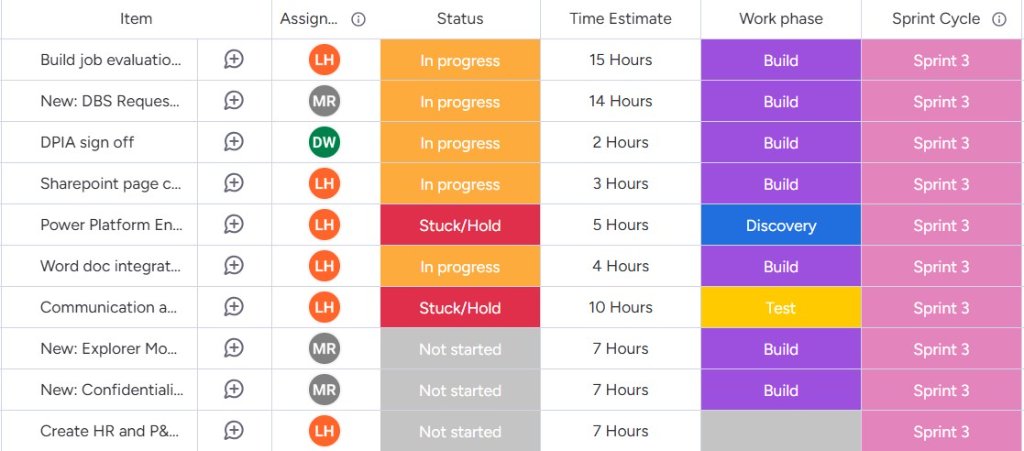
Ideas and requests are captured on a shared work board, which we have created and are managing through monday.com. This gives us one place to record new work, track progress, manage priorities and maintain visibility across the Technology and Digital service area.
Each week, the Digital Relationship Leads bring newly triaged items to the Technology and Digital Heads of Service meeting. Before this point, they carry out a light triage, which may include further conversations with the service area, colleagues within Technology and Digital, or third-party suppliers where needed.
At the weekly meeting, items are discussed and assigned to the appropriate service area. For example, a new website idea would be assigned into the Digital area and then managed through the web team's backlog and sprint planning process.
This means that work is not only captured consistently but also routed to the right people at the right time, with clearer ownership and a more structured path from idea to delivery.
How we process and prioritise work
One of the biggest benefits of the new approach is that it removes much of the technology and digital governance burden from individual services. The Digital Relationship Leads, working with the relevant Heads of Service, can help consider areas such as cyber security, procurement, data governance, technical feasibility and wider architectural fit.
Some ideas may need more detailed discovery before they can be assigned for delivery. This might involve business analysis, input from technical specialists, supplier engagement, options appraisal or a clearer understanding of scope, benefits, risks and dependencies.
The work board allows us to manage these items transparently. Heads of Service can view and manage their own areas of work, while the wider Technology and Digital leadership team can review demand across the whole directorate. We are also using the board to explore prioritisation approaches, including alignment to the corporate plan and annual delivery plan, alongside a lightweight prioritisation matrix loosely based on the RICE model.
Because the board can create different views, we can also build directorate-specific roadmaps. These views are helping our Digital Relationship Leads provide regular updates at directorate management team meetings, show what is happening for each area, and support senior leaders in shaping priority, pace and sequencing.
Once an item is assigned to a Head of Service, it is taken forward through the most appropriate delivery route. In the Digital service, for example, website-related work is added to the web team backlog, while productivity-related work is added to the productivity team backlog for sprint planning.
The benefits so far
The new team and approach have been well received by staff across the council, and services have engaged really positively.
Before this approach, services did not always have a clear route for early digital and technology conversations. Ideas could arrive through different channels, at different levels of maturity, and with varying amounts of information. We are now able to be more proactive, and instead of becoming involved late in the process, when a service has already shaped a solution, we can support early ideation and discovery. That helps services understand the digital and technology options available and gives us the opportunity to guide decisions before time and effort are committed in the wrong direction.
The clearer point of contact has also been valued. Services know who to speak to when they have a new idea, want to understand progress, or need help working through a challenge. Rather than submitting something into a process with limited visibility, they can have a conversation, send a message or pick up an issue through the regular engagement rhythm with their Digital Relationship Lead.
For the Technology and Digital service, the approach has improved how we understand and manage demand. New work is coming through a more consistent route, being filtered and triaged more effectively, and reviewed regularly by the relevant senior leads. This gives us a better overall view of capacity, priorities and emerging opportunities.
What comes next
This is still a new process and we are continuing to refine it as we learn. We want to extend our outreach across more services and teams, strengthen the regularity of engagement, and keep improving the way we use our work boards to surface the most useful information for services, directorates and senior leaders.
We are also looking at how this approach connects with the work of the transformation team. Alongside this, we want to improve our discovery processes, strengthen communication around status and readiness, and make it clearer when work can start. By building stronger relationships with directorates and understanding their priorities over time, we can better shape roadmaps, manage demand and support continuous improvement.
It has been a strong start. The team is learning quickly and improving the process as it goes. Building this new function from the ground up has challenged us to think through every aspect of this new service and the way it works – that has been a really exciting and enjoyable process to go through and helped us achieve clarity through constant review and agile adjustments.
Most importantly, it is helping us build better relationships with services, make digital and technology conversations more accessible, and ensure new ideas are shaped, prioritised and delivered in a more open and coordinated way.